Unicorn Back to School Sublimation: Creative Fuel for Educators, Makers, and Small Business Owners
Back-to-school season isn’t just about notebooks and backpacks anymore—it’s a vibrant cultural moment where identity, expression, and emotional resonance intersect with practical needs. At the heart of this shift lies a growing demand for customizable, joyful, and meaningful design assets—especially those that speak to inclusivity, wonder, and gentle confidence. Unicorn Back to School Sublimation collections answer that need with precision: high-resolution, versatile digital artwork built not just for aesthetics, but for real-world production workflows across education, retail, and creative entrepreneurship.
Why This Niche Resonates Beyond Trendiness
Unicorns have long transcended childhood fantasy to become symbols of individuality, resilience, and quiet magic—qualities especially relevant in today’s learning environments. When paired with “back to school,” the motif gains layered meaning: it reflects students’ hopes for fresh starts, teachers’ desire to foster safe and inspiring classrooms, and small business owners’ need for products that stand out without relying on cliché slogans or overused graphics. Unlike generic school-themed clipart, thoughtfully crafted Unicorn Back to School Sublimation designs carry narrative weight. Each piece invites interpretation—whether as a subtle nod to neurodiversity, a celebration of self-expression, or simply a visual breath of calm amid academic pressure.
Technical Foundations: What Makes These Files Production-Ready?
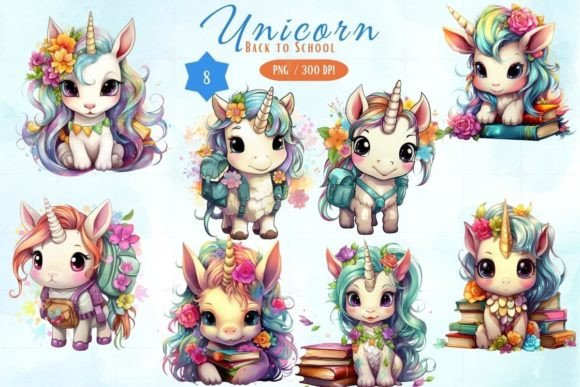
The package delivers eight distinct baby unicorn illustrations—all rendered at 4096×4096 pixels, 300 DPI, PNG format with transparent backgrounds. That resolution isn’t arbitrary. It ensures crisp scaling across multiple output methods: sublimation presses (ideal for polyester mugs, tumblers, and apparel), direct-to-garment (DTG) printing on cotton blends, inkjet transfer for craft projects, and even screen printing when used with proper separation workflows. The transparency eliminates tedious background removal—a time-saver for educators designing classroom posters or makers batch-producing stickers for student reward systems.
Compatibility isn’t theoretical here. These files are tested against industry-standard color profiles (sRGB) and structured to retain integrity through common raster-to-vector conversion pipelines. While they’re delivered as raster images, their clean edges and intentional negative space allow reliable tracing in vector editors—making them adaptable for embroidery digitizing or laser-cutting templates when needed.
Educators: Building Belonging Through Visual Language
In elementary and special education settings, visual cues shape emotional safety. A teacher might use one of the baby unicorn designs to personalize name tags, laminated behavior charts, or sensory break cards—transforming functional tools into affirming objects. Because the artwork avoids anthropomorphism (no exaggerated facial expressions or complex poses), it remains accessible to learners across developmental stages and communication styles. Some Montessori practitioners report using scaled-down versions as part of “peace corner” décor, reinforcing calm transitions without verbal instruction.
Small Business Owners: Scaling Joy Without Compromising Quality
For micro-businesses selling custom back-to-school gear—think Etsy shops, local craft fairs, or school PTA fundraisers—these files reduce overhead while increasing perceived value. One shop owner in Oregon shared how she printed the same unicorn motif across three product lines: heat-transfer vinyl on canvas tote bags for incoming kindergarteners, sublimated ceramic pencils cups for teachers, and matte-finish greeting cards for “first day” notes. Because all assets share consistent line weight and color harmony, customers recognized her brand instantly—even without logos. That cross-product cohesion is rare in low-cost design bundles—and critical for repeat purchases.
Content Creators & Hobbyists: Fuel for Iterative Experimentation
Hobbyists exploring dye-sublimation often stall at the design phase—not due to lack of skill, but because sourcing trustworthy, commercially viable art eats into creative time. With these files, experimentation becomes frictionless. Try adjusting saturation for pastel-themed bulletin boards, applying duotone filters for vintage-style notebook covers, or layering with hand-lettered quotes in Canva for printable wall art. The transparent background enables non-destructive compositing, so creators can test typography pairings, shadow effects, or texture overlays before committing to physical output.
Practical Considerations Every User Should Know
Color fidelity remains one of the most frequent pain points in digital-to-physical workflows—and it’s where expectations must align with reality. Monitors vary widely in gamma, brightness, and white point calibration; consumer-grade printers interpret RGB differently than commercial sublimation inks. That’s why the note about potential color variation isn’t boilerplate—it’s an essential acknowledgment of material science. Users who calibrate monitors using free tools like DisplayCAL or print test swatches on their target substrate consistently report stronger alignment between screen and final product.
Equally important: watermark absence doesn’t imply unrestricted licensing. These files are intended for end-product creation—not resale as standalone digital assets or inclusion in design subscription libraries. That distinction matters for educators repurposing materials for district-wide use or entrepreneurs building scalable product lines. Clarity around usage rights supports ethical practice and protects both creator and buyer.
Workflow Integration: From Download to Delivery
The instant digital download model accelerates iteration cycles significantly. Consider a homeschool co-op preparing for fall enrollment: instead of waiting weeks for custom illustration commissions, coordinators downloaded the set, resized two designs for fabric banners (using GIMP’s batch mode), exported optimized JPEGs for vinyl cutting, and had finished pieces installed before orientation day. That speed isn’t just convenient—it enables responsiveness. When a student requests a specific color scheme for their personalized folder, the team can adjust hue values and re-export in under five minutes.
For print-on-demand sellers, the 4096×4096 canvas provides headroom for platform-specific cropping. Redbubble accepts up to 4500px width; Printful recommends 3000px minimum for mugs—so these files sit comfortably within both constraints while preserving detail. No upscaling artifacts. No pixelation on curved surfaces. Just predictable, professional-grade input.
Design Philosophy Embedded in Every Pixel
What separates this collection from algorithmically generated alternatives is its restrained elegance. The baby unicorns avoid cartoonish exaggeration—their proportions are grounded, their postures relaxed, their horns subtly spiraled rather than aggressively pointed. This aesthetic choice serves function: softer silhouettes integrate more gracefully into minimalist classroom layouts or modern nursery themes. It also allows for ageless reinterpretation. A fifth grader might see adventure; a high school art student might analyze line economy; a kindergarten teacher might focus on the gentle curve of a lowered head as a nonverbal cue for “take a breath.”
That multiplicity of reading is intentional—and deeply aligned with current pedagogical research on multimodal literacy. Visuals that invite open-ended engagement support language development, emotional vocabulary building, and collaborative storytelling—skills increasingly emphasized in state standards from California to Maine.
Staying Current in a Rapidly Evolving Space
The note about regular new product updates reflects more than marketing strategy—it mirrors how creative industries actually operate. Trends in educational psychology (like increased emphasis on social-emotional learning), shifts in textile technology (e.g., eco-friendly sublimation inks), and emerging platforms (TikTok-driven demand for printable study planners) all influence what makes a design “useful” month to month. A collection updated quarterly can incorporate feedback loops: perhaps adding bilingual label variants after requests from dual-language programs, or introducing simplified outlines for younger learners following usability testing in early-childhood centers.
This responsiveness distinguishes curated digital asset libraries from static stock repositories. It treats design not as decoration, but as infrastructure—something that evolves alongside its users’ changing needs.
Final Thought: Tools Shape Practice
At its core, Unicorn Back to School Sublimation represents a quiet but powerful shift: away from viewing creativity as an isolated talent, and toward recognizing it as a learnable, shareable, and embeddable system. Whether you’re a curriculum designer selecting visuals for a trauma-informed lesson plan, a maker launching your first Shopify store, or a parent personalizing lunchbox notes, the quality of your foundational assets directly impacts the depth, reach, and sustainability of your work. Good tools don’t replace expertise—they amplify it. And when those tools carry warmth, precision, and respect for real-world constraints, they become more than files. They become collaborators.
Thanks for loving my super precious artwork 🙂 I would be even more than Happyyyy if you could spare a few minutes to visit my store for all the collections. Really appreciate your time. New Products are updated regularly.