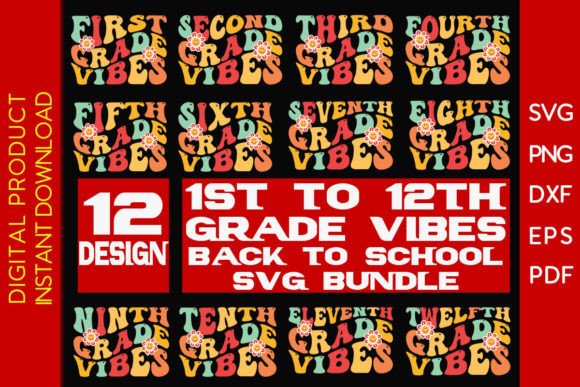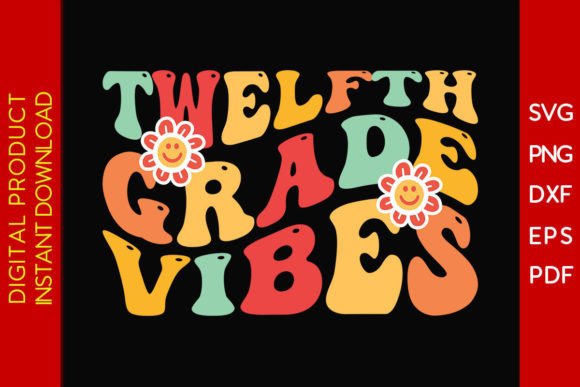
Twelfth Grade Vibes Back to School SVG
Twelfth Grade Vibes Back to School SVG is a ready-to-use digital design asset tailored for creators who need expressive, grade-specific visuals without the time or technical overhead of designing from scratch. It’s not just decorative—it’s functional infrastructure for educators preparing classroom materials, small business owners launching back-to-school merchandise lines, scrapbookers building memory keepsakes, or crafters producing personalized apparel and home décor. Unlike generic “Back to School” graphics, this set carries intentional tone and relevance: confident, reflective, and celebratory—aligned with the emotional and academic weight of senior year.
How It Fits Into Your Creative or Operational Workflow
Think of Twelfth Grade Vibes Back to School SVG as a modular component—not a standalone product, but a precision part that slots into existing systems. You don’t start your project *with* the SVG; you bring it in at the moment you shift from planning to execution. For example:
- An educator finalizing welcome packets for AP students pulls the SVG into Canva or Cricut Design Space to cut vinyl name tags with “Class of 2025” and a subtle cap-and-gown motif—adding consistency across printed handouts, digital slides, and physical bulletin boards.
- A small-batch apparel seller uses the EPS version in Adobe Illustrator to scale the design cleanly onto mockups, then exports print-ready files for DTG (direct-to-garment) production—cutting review cycles by eliminating manual vector cleanup.
- A homeschool parent organizing a senior-year milestone journal imports the PNG version into a digital scrapbooking tool like Scrapbook MAX!, layers it over photos and handwritten reflections, and exports high-res PDFs for printing.
In each case, the SVG isn’t the driver—it’s the accelerator. It reduces friction between intention and output, especially when timing matters (e.g., August classroom setup or early-fall product launches).
Compatibility and Integration Across Tools
The file package includes SVG, DXF, EPS, PNG, and PDF formats—deliberately chosen to cover both vector-based cutting workflows and raster-based design or print environments. That breadth means integration isn’t theoretical—it’s immediate:
- Cricut Design Space: Upload the SVG directly. No conversion needed. Use layers to separate text, icons, and decorative elements—ideal for multi-material projects (e.g., glitter vinyl text + matte black outline).
- Silhouette Studio: Import the DXF for precise contour cutting, or use the SVG for full-color print-and-cut jobs. The included PDF serves as a quick reference for sizing and layout alignment.
- Adobe Illustrator: Open the EPS or SVG to edit paths, adjust kerning, or recolor elements non-destructively. This matters if you’re adapting the design for brand guidelines or accessibility (e.g., increasing contrast for classroom posters).
- CNC Plasma or Laser Engraving: The DXF and EPS files retain clean vector paths—critical for accurate metal or wood cutting where even minor path distortion causes material waste or rework.
You don’t need to own all these tools—but knowing which format matches your current stack helps avoid delays. If you’re using Cricut Explore Air 2 today and plan to upgrade to Silhouette Cameo 5 next quarter, the bundled formats future-proof your purchase.
Practical Implementation Tips
Here’s what experienced users do differently:
- Unpack and organize first. Extract the ZIP archive into a dedicated folder labeled “Twelfth Grade Vibes – [Date]”. Rename files clearly (e.g., “TwelfthGradeVibes_SVG_CapAndGown”, “TwelfthGradeVibes_PNG_Transparent”)—this saves minutes every time you search for a specific variant.
- Test before scaling. Import the SVG into your cutting software at 100% size and run a test cut on scrap material. Some platforms auto-resize or interpret embedded units inconsistently—especially when moving between Cricut Design Space and Brother ScanNCut.
- Preserve layer integrity. In Silhouette Studio or Illustrator, avoid flattening layers unless necessary. Keep “text,” “border,” and “icon” on separate layers—this lets you toggle visibility, adjust spacing independently, or export subsets for different applications (e.g., just the icon for social media banners).
- Batch for consistency. If producing multiple items (e.g., 30 graduation caps for a class photo), group identical cuts in one mat. Use the alignment tools in your software—not manual placement—to ensure uniform spacing and orientation.
Long-Term Usability and Quality Control
This isn’t disposable content. Twelfth Grade Vibes Back to School SVG is built for reuse across years—not just for one August, but for ongoing senior-year programming: orientation kits, college application workshops, scholarship night signage, or alumni outreach. That longevity depends on how you handle three things:
- Version control. Save edited versions with clear suffixes (e.g., “_2025_ClassOfBanner”, “_2025_Badge_V2”). Don’t overwrite the original files—the source assets are your baseline for quality assurance.
- Color management. The PNG includes a transparent background; the vector files do not embed color profiles. If consistency matters across print and digital (e.g., matching a school website banner to physical posters), define your primary palette in advance and apply swatches uniformly in Illustrator or Silhouette Studio.
- Resolution awareness. Use SVG or EPS for anything requiring scalability (wall decals, large-format prints). Reserve PNG only for fixed-dimension uses like email headers or social media thumbnails—where pixel-perfect rendering matters more than infinite scaling.
Where It Fits in Broader Planning Cycles
Twelfth Grade Vibes Back to School SVG doesn’t replace strategy—it supports execution within it. Consider how it functions across phases:
- Before launch: Use the PDF preview to align stakeholders—share it with teachers, PTA members, or marketing teams to confirm tone and visual direction before investing in physical production.
- During rollout: Embed the SVG into editable templates (Google Slides, Notion dashboards, Canva brand kits) so non-designers can generate consistent assets without requesting revisions.
- After delivery: Archive the original ZIP alongside usage logs (e.g., “Used in 2024 Senior Orientation Kit, 37 printed items, 12 vinyl decals”). That data informs future budgeting, licensing needs, or refresh timelines.
It’s also a quiet leverage point for efficiency: one download replaces hours of searching stock sites, vetting licenses, adjusting proportions, or troubleshooting compatibility. That reclaimed time compounds—especially for educators juggling curriculum prep, IEP meetings, and extracurricular coordination.
Final Notes on Real-World Fit
If you’re evaluating whether Twelfth Grade Vibes Back to School SVG belongs in your toolkit, ask two questions:
- Do I regularly produce senior-year–themed materials—and do those materials need to feel distinct from general “Back to School” messaging?
- Do I work across multiple output channels (vinyl, print, digital, embroidery) where having native vector and raster assets saves repeated conversion steps?
If yes, this isn’t an add-on—it’s workflow hygiene. You’ll use it not because it’s trendy, but because it removes guesswork, preserves fidelity, and scales cleanly across people, platforms, and purposes. Once payment is completed, you receive a single download link. The files arrive in a ZIP archive—unpack it once, organize intelligently, and integrate where it tightens your loop between idea and outcome.