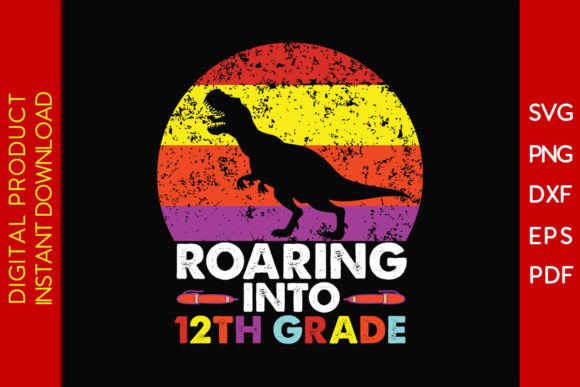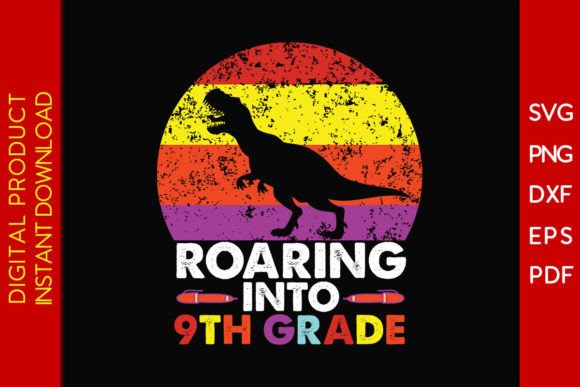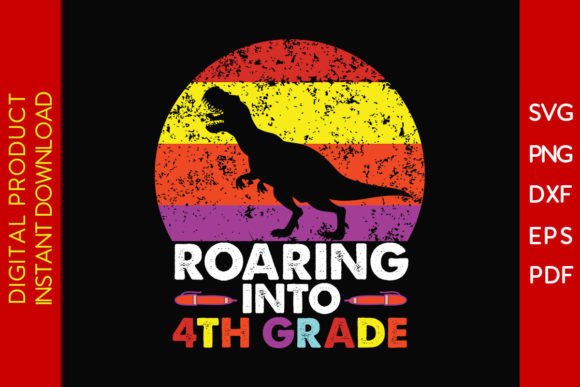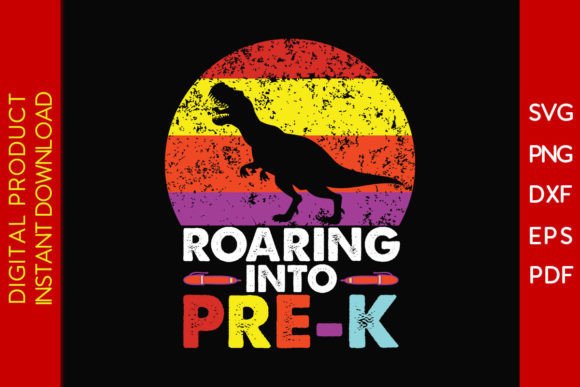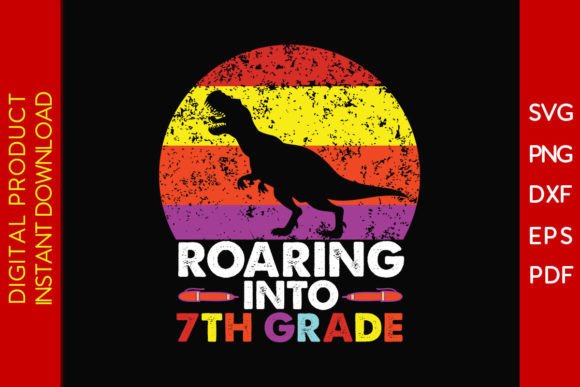
Roaring into 7th Grade Back to School
Back-to-school season isn’t just about notebooks and lunchboxes—it’s a strategic moment for creators, educators, small business owners, and hobbyists to align visual assets with real-world needs. Roaring into 7th Grade Back to School is a ready-to-use design bundle built for practical implementation: it’s not conceptual art or generic clipart. It’s a production-ready resource that plugs directly into workflows involving crafting, classroom preparation, small-batch merchandising, event planning, and personalized learning materials.
This bundle delivers one cohesive, high-fidelity file—packed in a ZIP archive containing SVG, DXF, EPS, PNG, and PDF formats. That multi-format structure isn’t decorative; it’s functional. Each format serves a distinct role in your process: SVG for web-based design platforms, DXF for precision cutting machines, EPS for vector editing in professional illustration tools, PNG for quick digital overlays or printed handouts, and PDF for print-ready layouts or sharing with collaborators who don’t use design software.
How Roaring into 7th Grade Back to School Fits Into Your Workflow
Think of this asset as a modular component—not a standalone product, but a building block. You’ll use it where visual consistency, age-appropriate tone, and thematic relevance matter most. For example:
- Educators embed the SVG version directly into lesson slide decks or classroom posters—scaling cleanly without pixelation, even on large interactive whiteboards.
- Small business owners importing the DXF file into Cricut Design Space or Silhouette Studio can cut vinyl decals for reusable classroom signs, locker labels, or custom t-shirts sold at school spirit fairs.
- Freelance designers open the EPS in Adobe Illustrator to adjust colors, layer text, or integrate with existing brand guidelines before delivering final files to clients (e.g., a PTA organizing a 7th-grade welcome event).
- Hobbyists and parents use the PNG at 300 DPI for scrapbooking pages, greeting cards, or printable reward charts—no software required beyond basic photo editors or word processors.
The timing of use matters less than the intention behind it. You might pull Roaring into 7th Grade Back to School early in your planning cycle—to prototype signage mockups—or later, as a finishing touch when assembling physical kits. It supports iterative work: test a layout in Design Space, tweak spacing in Illustrator, then export a clean PDF for printing at a local shop—all from the same source file.
Compatibility and Setup: Minimizing Friction
Before importing, confirm your software supports the format you need. Most modern cutting and design platforms—including Cricut Explore, Silhouette Cameo, Brother ScanNCut, CNC Plasma controllers, and Adobe Illustrator—handle SVG and DXF natively. If you’re using older versions of Silhouette Studio, note that DXF import may require the Designer Edition or higher. EPS works reliably in Illustrator and InDesign but isn’t editable in basic raster tools like Canva or PowerPoint.
Unpacking the ZIP archive is the only required setup step. No registration, no license keys, no subscription prompts. Once downloaded, the files sit locally—ideal for offline work, shared drives, or environments with limited internet access (like school computer labs). There’s no cloud dependency, which means version control stays simple: rename folders by project date or client name, and keep backups alongside other design assets.
Practical Implementation Tips
Start with your output goal. Ask: “Will this be cut, printed, or displayed digitally?” That determines your first format choice. Cutting vinyl? Prioritize DXF or SVG. Prepping a handout? Use PNG or PDF. Building a layered digital template? Open the SVG in Design Space or the EPS in Illustrator.
Respect layer structure. The files are organized with intentional layers—outline shapes, fill areas, and optional text elements separated logically. Don’t flatten unless necessary. Preserving layers lets you toggle visibility, recolor individual components, or isolate parts for reuse (e.g., extracting just the roaring lion graphic for a separate bulletin board).
Scale with confidence. Vector formats (SVG, DXF, EPS) scale infinitely without quality loss. But if you’re exporting to PNG for print, ensure your resolution setting is at least 300 DPI at final size. Avoid upscaling low-res PNGs—you’ll introduce blur or jagged edges.
Test before committing. Run a single cut on scrap material before loading expensive vinyl. Print a small section of the PDF on plain paper to verify alignment and color fidelity. Small checks prevent rework later—especially valuable when preparing for time-sensitive deadlines like orientation week or open house events.
Integration With Broader Systems
Roaring into 7th Grade Back to School doesn’t exist in isolation. It works best when aligned with your existing systems:
- Inventory management: If you stock blank apparel or pre-cut vinyl, tag this design with SKU-like identifiers in your spreadsheet so it’s findable next year—or three years from now—when 7th-grade enrollment spikes again.
- Content calendars: Schedule social media posts featuring student-made items using this design (e.g., “Meet Maya—she designed her own 7th-grade welcome shirt using our Roaring Into 7th Grade files”). That adds authenticity and shows real-world application.
- Curriculum planning: Tie the lion motif to growth mindset lessons—roaring as courage, voice, or readiness. The visual becomes part of pedagogy, not just decoration.
- Client onboarding: For designers serving schools or tutoring centers, include this file in your starter kit alongside editable templates and style guides. It signals preparedness and saves clients hours of sourcing.
Long-Term Usability and Quality Control
This bundle was built for reuse—not one-off projects. The vector foundation ensures longevity: no obsolescence from screen resolution shifts or printer upgrades. Colors follow standard CMYK/RGB profiles, so what you see in Illustrator matches closely to printed results. Text elements are outlined (not live fonts), eliminating missing-font errors across devices or team members’ machines.
For quality control, maintain a checklist when deploying:
- Verify format compatibility with your current software version.
- Confirm dimensions match intended use (e.g., 12" x 12" for a wall decal vs. 4" x 4" for a badge).
- Check contrast ratios if printing for accessibility (e.g., dark text on light background for readability).
- Archive both original and modified versions—label clearly (e.g., “Roaring_7th_SVG_v2_Cricut_Optimized”).
Because you receive only one download link post-purchase—and no recurring access—you’ll want to store the ZIP in at least two locations: a local drive and a secure cloud backup. Consider adding a brief README.txt inside the unzipped folder noting intended uses, compatible machines, and revision history. That small habit pays off during busy back-to-school weeks when memory fails but documentation doesn’t.
Ultimately, Roaring into 7th Grade Back to School succeeds not because it’s flashy, but because it removes friction. It gives you a consistent, production-grade starting point—so you spend less time hunting for assets and more time executing what matters: supporting students, launching products, teaching effectively, or building something meaningful with your hands or your team.