Back to School Cartoon Dog Vector Shirt: A Versatile Digital Design Resource for Educators, Makers, and Small Businesses
As classrooms reopen and creative projects ramp up each August, the Back to School Cartoon Dog Vector Shirt emerges not just as a seasonal motif—but as a practical, scalable digital asset with wide-ranging utility. Unlike physical apparel, this is a high-fidelity vector-based design delivered as a digital download—engineered for adaptability across platforms, tools, and real-world applications. Its cheerful, approachable cartoon dog illustration balances playful energy with clean visual structure, making it especially effective in educational environments, craft workflows, and small-batch merchandise production.
Why Vector Format Matters for Real-World Use
At its core, the Back to School Cartoon Dog Vector Shirt is built using mathematical paths rather than pixels. That distinction enables infinite scalability without loss of clarity—a critical advantage whether you’re printing on toddler-sized backpacks or projecting onto a 6-foot classroom banner. The inclusion of multiple native vector formats—AI (Adobe Illustrator), EPS, SVG, and DXF—ensures compatibility across diverse software ecosystems. For example:
- SVG integrates seamlessly into web-based learning platforms and interactive lesson builders;
- DXF supports precise routing in CNC engraving and laser-cutting workflows used by makerspaces and vocational programs;
- EPS remains widely accepted by commercial print providers for bulk school supply orders;
- AI allows educators or designers to modify layers, typography, or color schemes directly within industry-standard vector editing software.
The accompanying PNG file—rendered at 300 DPI with transparent background—provides immediate usability for digital presentations, printable handouts, or social media announcements. This multi-format delivery reflects an understanding that users operate in varied technical contexts—from K–12 art teachers using free online editors to professional sign shops running industrial vinyl cutters.
Educational Settings
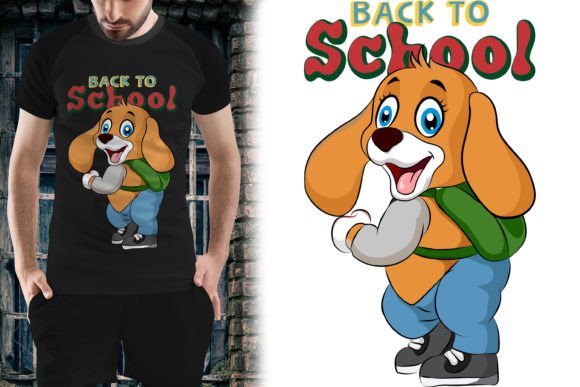
In schools, the Back to School Cartoon Dog Vector Shirt functions beyond decoration. Its friendly canine character serves as a visual anchor in orientation materials, helping reduce anxiety for new students. Teachers embed it into editable classroom rules posters, behavior charts, or “All About Me” templates—customizing colors to match grade-level themes (e.g., blue for third grade, green for science units). Because the vector layers are organized logically—separate paths for ears, collar, eyes, and text—modifications take seconds, not hours.
Craft and Maker Communities
Hobbyists using Cricut, Silhouette, or Brother ScanNCut machines rely on clean vector paths for accurate cutting. The DXF and SVG files included with this design contain no raster effects, embedded fonts, or compound clipping masks—common pitfalls that cause misalignment or toolpath errors. Users report success applying the cartoon dog to iron-on transfers for student welcome t-shirts, custom vinyl decals for locker labels, or engraved wooden name tags. One homeschool co-op even adapted the design into a reusable felt board set by exporting individual elements as SVG and cutting them from adhesive-backed felt sheets.
Small Business and Community Outreach
PTAs, tutoring centers, and after-school programs use the design to maintain brand consistency across touchpoints. Rather than commissioning custom artwork for every initiative, teams modify the base vector to reflect their logo colors or add localized text (“Maplewood Elementary 2024”), then deploy it across flyers, email headers, and digital signage. Because the files are royalty-free for internal and promotional use (per standard commercial license terms), there’s no recurring fee or attribution requirement—making budget-conscious scaling possible.
Editing Workflow: Accessible Yet Precise
Customization requires minimal technical overhead. In Adobe Illustrator, changing the dog’s collar color involves selecting the relevant path group, opening the Color panel, and entering a HEX or RGB value—or dragging a swatch from a school’s official palette. Photoshop users can achieve similar results via Select > Subject, followed by adjustment layers applied to masked areas—ideal when preparing PNG variants for printed invitations or laminated flashcards.
For users unfamiliar with desktop software, browser-based tools like Inkscape (free and open-source) or Vectr support SVG import and basic recoloring. Even Canva users can upload the PNG version and apply filters or overlays—though vector edits retain superior fidelity for repeated resizing.
Design Integrity and Production Readiness
What distinguishes this Back to School Cartoon Dog Vector Shirt from generic clip art is its intentional construction. Stroke weights remain uniform at all scales; anchor points are simplified to prevent rendering glitches on low-end devices; and overlapping shapes use non-destructive Pathfinder operations rather than flattened bitmaps. These choices ensure reliability whether the file is opened on a 2015 MacBook Air or a modern Windows tablet running CorelDRAW.
The design avoids overused tropes—no apples, no chalkboards, no exaggerated graduation caps. Instead, it leans into warmth and inclusivity: the dog wears a simple backpack and friendly expression, inviting interpretation across cultural and linguistic contexts. Educators in bilingual districts have repurposed the base image by adding translated welcome phrases in layered text boxes—preserving original proportions while accommodating dual-language instruction needs.
Considerations Before Download
While the package delivers five distinct file types compressed into a single ZIP archive, users should verify extraction compatibility with their operating system. On macOS, double-clicking the ZIP usually suffices; Windows users may need WinRAR or 7-Zip if default utilities fail to recognize the archive format. It’s also advisable to check folder permissions—especially in shared school computer labs—where restricted user accounts sometimes block automatic decompression.
Importantly, this is a digital download only. No physical shirt, fabric, or printed sample ships. Customers receive files optimized for self-production—not pre-made garments. That model empowers autonomy but assumes baseline familiarity with output methods: heat press settings for cotton tees differ from those required for polyester performance wear, and vinyl application temperature varies between permanent and removable adhesive types.
Broader Implications for Digital Asset Literacy
The rise of accessible, multi-format vector resources like the Back to School Cartoon Dog Vector Shirt signals a shift toward democratized design literacy. When educators, parents, and small organizations can ethically reuse, remix, and redistribute vetted assets, they invest time in pedagogy—not pixel-pushing. Researchers studying maker education note that consistent access to editable visuals correlates with increased student engagement in project-based learning units. Similarly, business owners report faster campaign turnaround when foundational assets are modular and well-documented.
This isn’t about replacing professional designers—it’s about lowering barriers to implementation. A PTA president doesn’t need to hire a freelancer to create a cohesive back-to-school campaign; she can adjust colors, add dates, and export ready-to-print files in under 20 minutes. A robotics club advisor can laser-engrave the cartoon dog onto acrylic awards without outsourcing vector cleanup. A speech-language pathologist might isolate the dog’s mouth shape to build articulation practice cards—all because the source file was structured with intentionality, not convenience.
Final Thoughts on Utility Over Aesthetics
Ultimately, the value of the Back to School Cartoon Dog Vector Shirt lies less in its visual charm and more in its functional architecture. Its strength emerges in quiet moments: when a teacher prints 30 identical welcome badges before homeroom, when a teen entrepreneur cuts 50 stickers for her first Etsy order, when a community center updates its annual orientation slideshow without waiting for vendor approvals. It’s a tool shaped by constraints—file size, software limits, accessibility standards—and refined through iterative feedback from actual users.
That practical grounding makes it resilient across trends. While illustration styles evolve, vector fundamentals endure. As long as schools reopen, makers create, and small teams seek efficient ways to communicate warmth and readiness, resources like this remain quietly indispensable—not as novelties, but as infrastructure.