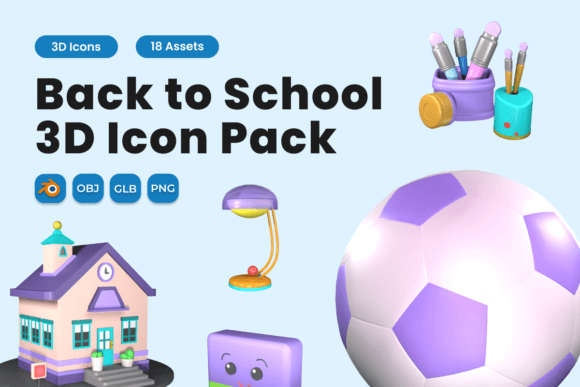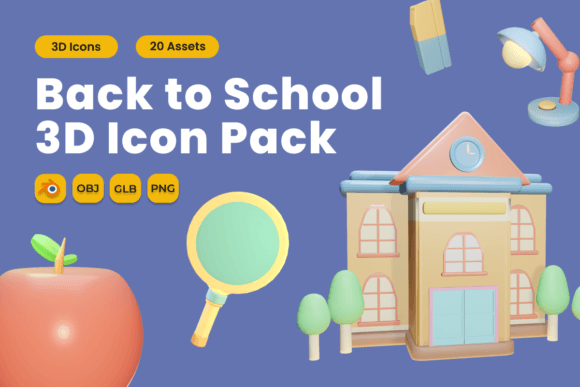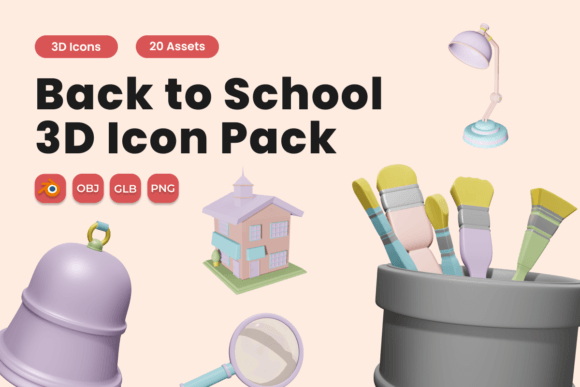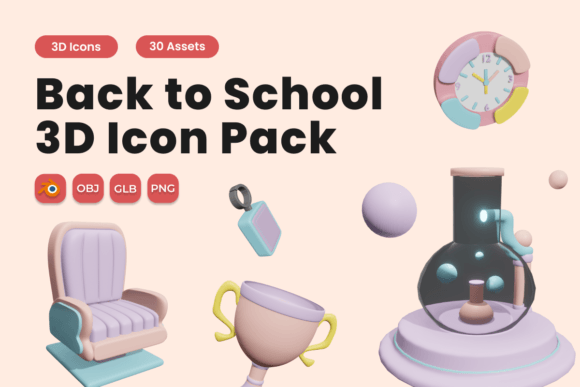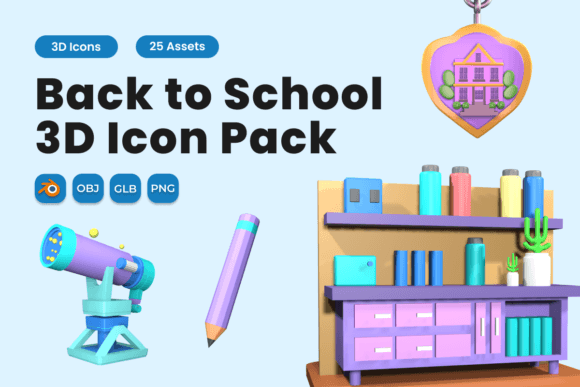
Back to School 3D Icon Pack Vol 3: Elevating Educational Design with Depth, Detail, and Versatility
Designing for the back-to-school season demands more than seasonal relevance—it requires visual resonance. Educators crafting classroom posters, marketing teams launching school supply campaigns, UI designers building learning apps, and small business owners promoting tutoring services all face the same challenge: how to communicate academic energy, growth, and engagement at a glance. Enter the Back to School 3D Icon Pack Vol 3—a thoughtfully curated set of dimensional assets that bridges aesthetic appeal with functional precision. Unlike flat or stylized icons, this collection leverages true 3D modeling techniques to deliver tactile realism, lighting-aware surfaces, and spatial presence—qualities increasingly valued in modern digital and print communication.
Why Dimension Matters in Educational Visual Communication
Human perception is inherently three-dimensional. When viewers encounter an icon with visible depth—subtle shadows under a backpack strap, glossy highlights on a laptop screen, or textured grain on a notebook cover—their brain registers it as more tangible, credible, and memorable. This isn’t merely stylistic preference; cognitive research shows that realistic rendering improves recognition speed and recall, especially among younger audiences and diverse learners. In practice, a 3D pencil icon used in a phonics worksheet doesn’t just signal “writing”—it subtly reinforces fine motor action through visual weight and perspective. Similarly, a 3D globe icon with visible continents and atmospheric glow can anchor geography lessons far more effectively than its flat counterpart.
The Back to School 3D Icon Pack Vol 3 capitalizes on this principle across its full set of 25 icons. Each model was built from scratch—not extruded from 2D shapes—to ensure anatomical accuracy and material fidelity. A calculator icon features subtle metallic sheen and button indentation; a stack of books displays varied spine textures, slight warping, and realistic shadow overlap; even abstract concepts like “learning” or “progress” are rendered through layered 3D arrows, ascending steps, or dynamic light paths—all grounded in physical logic.
File Flexibility for Real-World Workflows
A powerful icon set loses value if it can’t adapt to actual production environments. The Back to School 3D Icon Pack Vol 3 anticipates this by delivering each icon in four complementary formats: BLEND, OBJ, GLB, and PNG. This isn’t redundancy—it’s strategic interoperability.
- BLEND files (Blender-native) allow designers to adjust lighting, materials, camera angles, or even modify geometry—ideal for customizing icons to match brand color palettes or integrating them into larger 3D scenes like virtual classrooms or animated explainer videos.
- OBJ files offer universal compatibility with industry-standard 3D tools including Maya, Cinema 4D, and Fusion 360—making them suitable for educators developing AR science demos or developers embedding interactive models into educational platforms.
- GLB files (the binary form of glTF) enable direct, lightweight integration into web-based applications, Unity projects, or Three.js visualizations—no conversion needed. A school district’s website could feature rotating 3D icons in navigation bars or loading animations without performance penalties.
- PNG files provide immediate usability: high-resolution, transparent-background raster assets ready for Canva flyers, PowerPoint presentations, Google Slides templates, or social media banners—no 3D software required.
This multi-format structure supports users across experience levels. A teacher using Google Workspace can drop in PNGs instantly. A freelance designer building a responsive e-learning dashboard might import GLB files for micro-interactions. An edtech startup prototyping a VR study tool may use OBJs to align icons with spatial audio cues. The pack doesn’t assume a single workflow—it accommodates many.
Practical Applications Across Audiences
The strength of the Back to School 3D Icon Pack Vol 3 lies in its contextual adaptability—not just thematic alignment. Consider how different professionals apply these assets:
Educators & Instructional Designers
In lesson planning, consistency matters. Using matching 3D icons for “research,” “analyze,” “present,” and “reflect” creates visual scaffolding that reinforces process-oriented thinking. One middle school science department replaced generic clipart with these icons in their inquiry-based unit guides—reporting improved student task initiation and reduced cognitive load during transitions between activity phases.
Small Business Owners & Tutors
Local tutoring centers, after-school programs, and homeschool co-ops often operate with limited design resources. These icons serve as modular branding elements: a 3D magnifying glass over a textbook becomes a recognizable logo; a 3D graduation cap appears consistently across Instagram Stories, email headers, and printed enrollment forms—building familiarity without requiring custom illustration.
Web & App Developers
Accessibility considerations extend beyond contrast ratios and alt text. Animated 3D icons—exported from the provided BLEND or GLB files—can provide non-verbal feedback: a gently pulsing 3D bell icon signals new announcements; a rotating 3D lightbulb animates when a concept is unlocked in a gamified learning app. Because the source models include clean topology and UV-unwrapped textures, developers avoid common pitfalls like distorted normals or inconsistent scaling.
Marketing & Communications Teams
School districts, PTA groups, and education nonprofits frequently juggle tight deadlines and broad messaging goals. Rather than commissioning bespoke illustrations for every campaign—“STEM Week,” “Literacy Night,” “Parent-Teacher Conferences”—teams reuse and recombine icons from the pack. A 3D backpack paired with a 3D bus icon conveys transportation logistics; the same backpack beside a 3D heart icon communicates school safety initiatives. This modularity accelerates iteration while maintaining visual cohesion.
Design Integrity and Technical Considerations
Not all 3D icons are created equal. Some prioritize novelty over usability—overly complex geometry, inconsistent scale, or exaggerated perspective that breaks layout harmony. The Back to School 3D Icon Pack Vol 3 avoids these traps through deliberate constraints:
- Unified scale system: All icons share a consistent base height (e.g., 512px tall in PNG), ensuring alignment in grids and dashboards without manual resizing.
- Controlled polycount: Models balance detail and efficiency—optimized for real-time rendering without sacrificing texture richness. No icon exceeds 25,000 polygons, making them viable for mobile interfaces and low-bandwidth contexts.
- Neutral lighting setup: Base renders use soft, directional lighting—avoiding harsh shadows that would limit background versatility. Users can relight freely in BLEND or GLB environments.
- Color-agnostic materials: Textures use physically based rendering (PBR) principles, meaning colors respond predictably to lighting changes—critical for maintaining brand integrity across mediums.
These decisions reflect deep understanding of both design systems and implementation realities. They also make the pack future-proof: as WebGPU adoption grows and browser-based 3D rendering becomes standard, GLB assets from this pack will remain directly deployable—no re-exporting or format migration required.
Beyond Decoration: Supporting Inclusive and Engaging Learning Environments
Icons do more than decorate—they shape perception. A 3D icon of students collaborating around a tablet, rendered with varied skin tones, gender-neutral clothing, and visible assistive devices (like a braille notetaker or hearing aid), communicates belonging more powerfully than any slogan. While the Back to School 3D Icon Pack Vol 3 focuses on objects and symbols rather than人物, its emphasis on realistic texture, proportion, and environmental context creates fertile ground for inclusive adaptation. Designers can modify existing models—swapping book covers for bilingual titles, adding sign language glosses to speech bubble icons, or adjusting lighting to emphasize tactile elements for visually impaired users.
Moreover, the tactile quality of 3D rendering supports multisensory learning strategies. When a child sees a 3D icon of a microscope with visible lens curvature and focus ring detail, it primes mental models before hands-on lab work. When a parent views a 3D icon of a calendar with clearly marked dates and color-coded events, it reduces ambiguity about scheduling. These are not passive visuals—they’re cognitive anchors.
In sum, the Back to School 3D Icon Pack Vol 3 represents a convergence of technical rigor, pedagogical awareness, and practical utility. It meets creators where they are—whether sketching wireframes in Figma, scripting WebGL interactions, or assembling a bulletin board—and gives them tools that perform, scale, and endure. Its value isn’t in novelty alone, but in how reliably it helps people communicate learning, growth, and community—with clarity, depth, and quiet confidence.