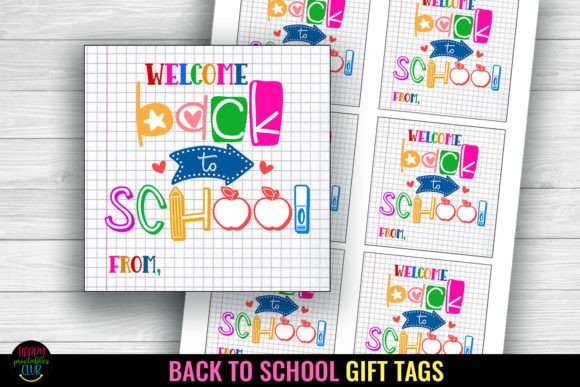
Welcome Back to School Gift Tag: Thoughtful, Printable, and Purpose-Built for Educators
As summer winds down and classrooms begin to hum with anticipation, one subtle but meaningful detail often gets overlooked—how we acknowledge the effort behind every first day. A Welcome Back to School Gift Tag isn’t just a decorative flourish; it’s a quiet gesture of appreciation, a tangible marker of intention, and a practical tool for educators, parents, and school communities alike. Unlike generic labels or mass-produced stickers, purpose-designed gift tags serve as micro-communications—conveying warmth, recognition, and respect in under ten seconds.
Why Context Matters More Than Decoration
A First Day of School Gift Tag functions differently depending on who holds it and how it’s used. For a kindergarten teacher receiving a hand-drawn card from a student, the tag may be taped to the back of a small jar of honey labeled “Sweet Start to the Year.” For a PTA coordinator preparing welcome kits for new staff, the same Welcome Back to School Gift Tag might anchor a bundle of classroom supplies, instantly signaling inclusion and support. The design, wording, and format all shape perception—not just aesthetics.
This is why downloadable digital files—like the 8.5 × 11-inch PDF, JPEG, and PNG versions included in many instant-download bundles—are gaining traction among educators and event planners. They offer flexibility without compromise: no shipping delays, no inventory limits, and full control over paper stock, print quality, and color calibration. You choose whether to print on matte cardstock for a tactile finish or glossy sticker paper for peel-and-stick convenience. That adaptability makes them especially valuable during tight seasonal windows—when Open House night is three days away and Meet the Teacher events are already scheduled.
Real-World Applications Beyond the Obvious
While the phrase Back to School Gift Tag evokes images of apples and pencils, its utility extends far beyond student-to-teacher exchanges. Consider these less-discussed but highly effective use cases:
- Staff Onboarding Kits: New hires—whether instructional aides, librarians, or counselors—often arrive without established classroom routines. Attaching a personalized Welcome Back to School Gift Tag to a welcome folder (with building maps, key contacts, and supply lists) transforms administrative paperwork into an empathetic welcome.
- Parent Volunteer Recognition: During Meet the Teacher events, volunteers frequently contribute time, materials, or expertise before the year begins. A small token—like a reusable tote bag or notebook—with a printed First Day of School Gift Tag acknowledges their early investment in the learning community.
- Classroom Transition Supports: For students moving between grade levels—especially in middle or high school—a tag affixed to a personalized planner or binder signals continuity. Phrases like “You’ve Got This” or “New Chapter, Same Brilliant You” reinforce identity and agency, not just novelty.
- Administrative & Support Staff Gifting: Custodians, cafeteria workers, office staff, and bus drivers rarely receive formal recognition on opening day—but they’re foundational to school operations. A simple tag paired with coffee mugs or snack boxes communicates institutional gratitude that aligns with equity-centered practices.
Design Integrity Meets Practical Functionality
The value of a well-crafted Welcome Back to School Gift Tag lies not only in its visual appeal but in its structural intelligence. Take the standard 8.5 × 11-inch file size: it’s not arbitrary. That dimension allows for efficient printing on home or office printers, supports multiple layouts per sheet (e.g., six 3×4-inch tags), and accommodates bleed and trim margins when cutting by hand or with a guillotine cutter. It also integrates seamlessly into existing workflows—many teachers already use this paper size for lesson plans, newsletters, and behavior charts.
Having all three formats—PDF, JPEG, and PNG—addresses distinct technical needs. The PDF preserves vector sharpness and typography fidelity, ideal for professional printing services or layered editing in Adobe Acrobat. The JPEG offers universal compatibility for quick uploads to online print platforms like Vistaprint or Shutterfly. And the PNG, with its transparent background, enables effortless layering in Canva or Google Slides—useful when customizing tags for bilingual classrooms or adding school logos without reformatting.
Yet realism matters too. As noted in product descriptions, screen-to-print color variance is inevitable. Monitors render RGB values differently than CMYK printers interpret them—and ambient lighting, screen calibration, and even viewing angle affect perception. Savvy users test-print a single tag first, adjust saturation or brightness in their editing software if needed, and select paper with appropriate brightness (90+ for crisp text, lower for warm, vintage tones). This attention to detail reflects deeper fluency—not just with design tools, but with how meaning is materially constructed.
Who Benefits—and How They Use It Differently
Though often associated with teachers and parents, the ecosystem around Back to School Gift Tags includes diverse stakeholders, each leveraging them in context-specific ways:
- Educators: Use tags to personalize welcome gifts for students (e.g., attaching them to reading journals or growth mindset bookmarks), differentiate materials for IEP or EL learners (“My Reading Buddy” or “Spanish Edition Inside”), or label shared resources during collaborative learning stations.
- PTA/PTO Leaders: Integrate tags into broader communications—pairing them with digital newsletters or QR codes linking to classroom supply lists or volunteer sign-up sheets. The physical tag becomes a bridge between analog and digital engagement.
- Small Business Owners: Local bookstores, craft shops, or tutoring centers print batches to include with purchases—turning transactions into relationship-building moments. A tag on a set of flashcards might read, “Grow Your Mind, One Question at a Time.”
- Homeschool Co-ops: Adapt tags for multi-age groupings—swapping “Kindergarten” for “Explorers Group” or “Grade 7–9 Science Circle”—reinforcing shared identity across non-traditional structures.
- Curriculum Designers & EdTech Developers: Embed tag language into onboarding emails or dashboard welcome modals—using the same tone, phrasing, and visual rhythm to create cross-platform consistency.
What to Consider Before Printing
Before hitting “print,” thoughtful users weigh several practical factors—none of which require design expertise, but all of which impact effectiveness:
- Purpose First: Is the tag meant to be read aloud (e.g., during morning announcements), handled repeatedly (on a reusable water bottle), or displayed briefly (on a gift bag)? Font size, contrast, and material durability shift accordingly.
- Accessibility Alignment: High-contrast color pairings (navy on cream, not yellow on white), sans-serif fonts at 12+ pt, and sufficient spacing between lines ensure readability for neurodiverse learners and aging staff alike.
- Cultural Resonance: Avoid assumptions about family structure (“Back to School with Mom & Dad”), religious references, or seasonal metaphors that may exclude students observing different holidays or living in hemispheres where August isn’t “back to school” season.
- Sustainability Signals: Choosing recycled paper or soy-based inks subtly reinforces institutional values—even when the tag itself is small. Some districts now include eco-certification badges alongside traditional branding.
Looking Ahead: Trends Shaping Future Use
Emerging patterns suggest that Welcome Back to School Gift Tag usage is evolving beyond tradition. There’s growing emphasis on student-authored tags, where learners draft messages for peers or teachers using sentence frames or illustrated templates—building literacy, empathy, and ownership simultaneously. Others integrate augmented reality: scanning a tag with a tablet reveals a welcome video from the principal or a 3D tour of the library.
Meanwhile, data-informed customization is rising—tags generated dynamically based on class rosters, reading levels, or home language preferences. A third-grade teacher might print one set saying “Ready for Chapter Books!” for advanced readers and another reading “Let’s Build Our Story Together” for emerging readers—all from the same base file, edited via mail merge.
None of these innovations diminish the core function of the tag. Rather, they deepen it—transforming a simple label into a node in a larger network of care, clarity, and connection. Whether printed on a laser printer at 6 a.m. or embedded in a district-wide digital platform, the First Day of School Gift Tag remains what it has always been: a deliberate pause in the rush of reopening—a way to say, quietly but firmly, You matter here. You belong. Let’s begin.